

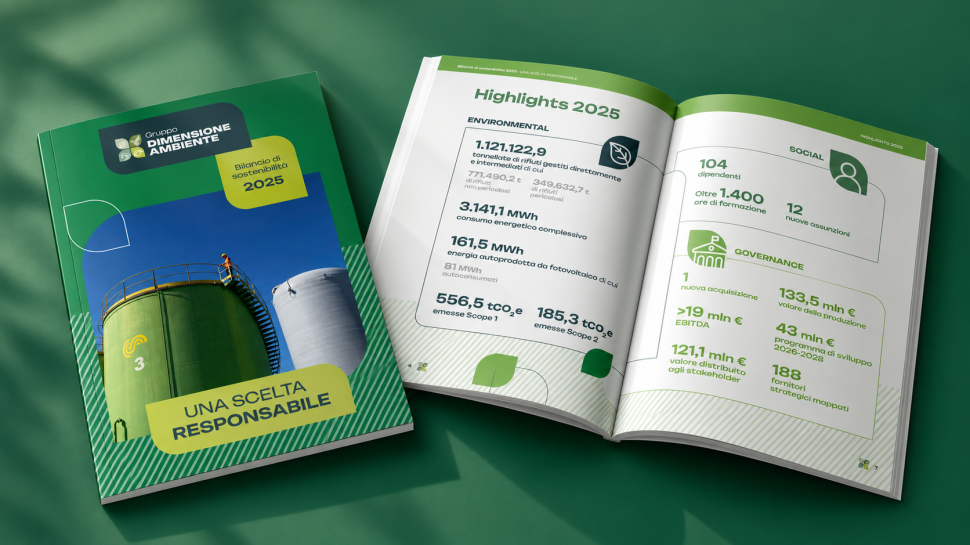
Dimensione Ambiente: a Sustainability Report that evolves alongside the Group
Dimensione Ambiente operates in the environmental services sector, specialising in the integrated management of hazardous and non-hazardous industrial and commercial waste, including treatment, recovery and disposal. The Group is a growing industrial business operating in a sector that plays a strategic role in environmental protection and the transition to a circular economy.
In 2026, Dimensione Ambiente continued to strengthen its environmental, social and governance reporting with the publication of its 2025 Sustainability Report, produced with Amapola’s support for the third consecutive year.
The report covers a year of strong business performance, with a value of production of €133.5 million, over 1.1 million tonnes of waste managed directly and through intermediaries, and a €43 million industrial development programme planned for 2026–2028.
Amapola’s role
Amapola supported Dimensione Ambiente throughout the development of its Sustainability Report, overseeing data collection, content development, and graphic design and layout.
The project builds on a partnership established in 2023, with the aim of progressively strengthening the Group’s sustainability reporting framework and making the activities and performance of a complex, highly regulated industrial business easier to understand.
Particular emphasis was placed on organising information and presenting it clearly, ensuring that ESG performance could be communicated effectively while highlighting the connections between sustainability and the Group’s core operations.
Compared with the previous edition, the 2025 report introduces new areas of analysis, broadening the scope and depth of the information disclosed.
How the report has evolved
The first major development concerns waste management, the Group’s core business. The report provides a more detailed breakdown of waste streams, examining their characteristics, origins, treatment methods and final destinations to offer greater insight into the Group’s industrial processes.
Another area of progress is the supply chain. For the first time, the Group has mapped its key strategic suppliers, analysing 188 businesses in terms of their geographical distribution and economic significance. This initial assessment lays the foundation for gradually extending sustainability reporting across the wider value chain.
Finally, the report introduces a mapping of the Group’s facilities in relation to biodiversity-sensitive areas, taking into account their proximity and the characteristics of the surrounding territories.
Together, these developments reinforce the role of sustainability reporting as a tool for understanding and managing business activities, particularly valuable as the Group continues to grow and expand its industrial operations.