
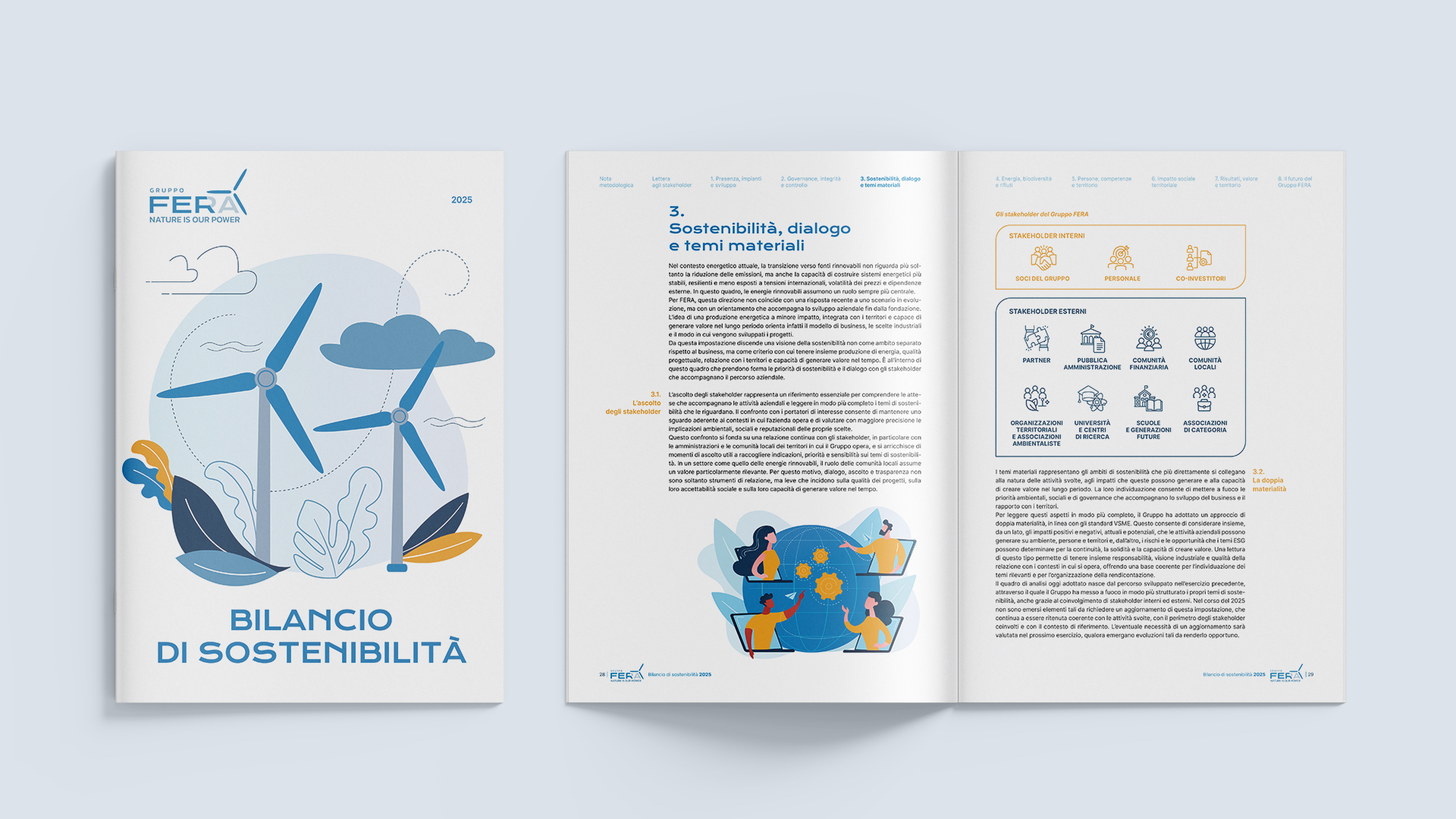
The renewable energy Group continues to strengthen its voluntary sustainability reporting journey, highlighting results, impacts and new strategic developments. Once again this year, Amapola supported the project team throughout the main stages of the process.
Go to the project
Making the value generated by renewable energy visible means measuring, communicating and sharing tangible results. This is the approach behind the new 2025 Sustainability Report by FERA – Fabbrica Energie Rinnovabili Alternative.
The report marks the latest step in FERA’s voluntary sustainability reporting journey and provides a clear and transparent picture of how its environmental, social and governance performance is evolving. Amapola has continued to support this process in line with previous editions, working alongside the internal team on reporting strategy, content collection and organisation, copywriting and the report’s visual design.
FERA: renewable energy, local communities and innovation
Active since 2001, the FERA Group operates in the renewable energy sector. Originally focused on wind power, it has progressively expanded its activities, developing design, operational and management expertise across the entire energy value chain.
The Group has developed, designed and built renewable energy plants with a total capacity of more than 200 MW and feeds clean electricity into the grid generated exclusively from wind, biogas and hydropower. Its approach combines energy generation with stakeholder engagement and ongoing dialogue with the communities and territories where it operates.
In 2025, this commitment translated into a tangible environmental result: the renewable energy supplied to the grid helped avoid approximately 90,200 tonnes of CO₂ emissions. A figure that provides an immediate measure of the positive impact generated by the Group’s energy production.
The 2025 Sustainability Report
FERA’s 2025 Sustainability Report presents the Group’s activities, results and commitments across ESG topics, with a particular focus on how performance is evolving over time.
The report was prepared with reference to the VSME – Voluntary Sustainability Reporting Standards for SMEs developed by EFRAG, applying both the Basic and Comprehensive Modules. This choice reflects the Group’s commitment to adopting a robust and progressive reporting framework aligned with the latest European developments in sustainability reporting for SMEs.
One of the most significant new elements in the 2025 edition is a qualitative assessment of the social impact generated by two wind farms, included in the report for the first time, together with an analysis of the impact of FERA’s activities on biodiversity in the areas concerned. This represents an important step in strengthening the connection between renewable energy generation, shared value creation and the sustainable development of local communities.
Amapola’s support
For FERA, we brought our expertise in sustainability reporting to every stage of the project.
Our work covered reporting strategy, document and data collection, copywriting, content organisation and the report’s visual design. The aim was to make data, results and commitments accessible and meaningful, turning the report into a clear and useful tool for stakeholders, clients, partners and local communities.
Infographics, data visualisation and other visual solutions were developed to make even the most technical information easy to understand. The report also features interactive navigation and clickable indexes, making it simple and intuitive to explore.
Because an effective Sustainability Report is more than a reporting document: it is a tool for dialogue, transparency and greater awareness.